
 Share
Share
Contributors: Ari Page and Kayla Page | 6 min read
Ranchers are selling fall calves for $300 to $400 a head less than they got two months ago. And 300,000 metric tons of tax free imported beef are landing right in the middle of that selling window.
3 Key Findings
Cow calf ranchers and feedlot operators take the hit first. Farm Bureau says calves are selling $300 to $400 below where they sold two months ago. Feed, fuel, payroll, and land rent did not drop to match.
The import window closes November 30. The beef comes in three monthly batches of 100,000 metric tons each. So the extra supply has an end date, even though rebuilding the national herd will take years.
Help for ranchers moves slower than the imports do. Two executive orders signed September 4 cover meat processing rights and labeling. Both need new rules or an act of Congress, so neither arrives during these 90 days.
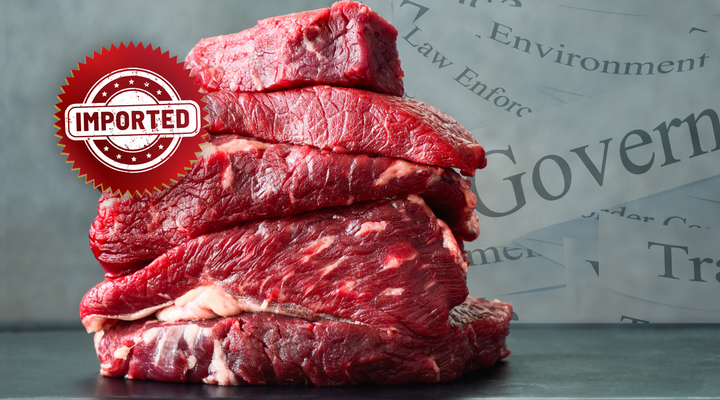
Ranchers moving calves this fall are selling into a market the federal government just changed. On August 26, 2026, President Donald Trump signed an order called "Further Ensuring Affordable Beef for the American Consumer." It lets 300,000 metric tons of imported lean beef trim, the meat blended into ground beef, come into the country without the usual 26.4% import tax for 90 days.
The beef arrives in three monthly batches of 100,000 metric tons. Importers claim each batch first come, first served. The first opened September 1. The last one closes when it fills up or on November 30, whichever comes first. That is almost exactly the stretch when hundreds of thousands of ranchers sell their calves.
The administration says the imported beef comes with a promise to sell it 25% below current market prices. The goal is cheaper ground beef, which now runs close to $6.89 a pound. Meanwhile, the USDA expects American beef production to drop about 4% from last year. The national herd sat at 86.2 million head on January 1, the smallest it has been since 1951.
For the ranchers, feedlot operators, and small meat processors on the supply side, the policy fight is over. What is left is a business question. How do you run an operation for the next three months when your income drops and your bills do not?
What This Does to a Cattle Operation's Numbers
The American Farm Bureau Federation reports ranchers selling calves $300 to $400 below where they sold two months ago. Beef imports in the first half of 2026 already hit a record 1.1 million metric tons, up 12% from last year. That was before the new batches started arriving. Farm Bureau puts the skipped import tax at close to $650 million.
Source: White House proclamation; American Farm Bureau Federation
Here is the part that hurts. A rancher who built this year's budget around spring cattle prices still owes the same on feed, diesel, vet bills, pasture rent, and equipment payments. None of those bills went down when the sale barn bid did. Ranchers who track their cost per pound, meaning what it costs to put a pound of weight on an animal, can see right where the new bid leaves them. For a lot of operations, it lands below break even.
Republican lawmakers from cattle states pushed back before the order was signed. Their argument was that ranchers were already running on thin margins. Independent operators have been paying high input costs for two seasons straight. That means this price drop hits with less savings behind it than the same drop would have in 2023.
Ranchers are doing what they can control. Some are keeping calves on grass longer to wait out the weak bids, which trades a lower price now for a higher feed bill later. Others are moving their sale dates away from crowded weeks. Feedlot managers are rewriting their purchase deals for replacement cattle to match lower beef prices. Every one of those moves costs money up front and takes time to pay off.
Where the Beef Is Coming From and What the September Orders Change
The signed order never named a single country. For two weeks the administration would not say where the beef was coming from. That changed on September 4, when the president spoke at a White House event surrounded by ranchers and farmers.
"It's coming from Argentina. It's coming from Brazil. It's coming from a couple of other places."
— Donald Trump, President of the United States, The Hill
That same event produced two executive orders aimed at helping American producers. The first gives ranchers and farmers more room to butcher, package, and sell their own meat across state lines. That is a direct shot at the four companies that handle most beef processing in this country. The second requires foreign beef to be labeled with its country of origin, which the president said he would send to Congress.
Neither one starts working the day it was signed. Labeling needs a law passed. The processing change needs new agency rules written. So a rancher planning fall sales should not count on either. The imported beef, on the other hand, is already coming through the ports.
The order is also narrower than the headline number makes it sound. It only covers lean beef trim, fresh and frozen, which gets mixed with American beef to make ground beef. Steaks and roasts are not included. And 300,000 metric tons is only about 2% of what the country eats. That is why analysts expect small savings at the grocery store even while it pushes cattle prices down.
Some details are still unclear. Agriculture Secretary Brooke Rollins told reporters she did not know the specifics of the order. Nobody has said publicly whether that 25% discount promise came from foreign governments, exporters, importers, or individual companies.
What Producers Are Doing Inside the Window
The processing order points toward something a lot of ranchers were already trying. Selling beef straight to families, local grocers, and restaurants keeps more of the retail dollar on the ranch instead of handing it to the packers. The catch is that it costs money before it makes money.
A real direct sales operation needs packaging equipment, retail permits, cold storage, and money behind finding customers. Small meat processors face their own list: cleaning system upgrades, more freezer space, and skilled cutters who are hard to find and expensive to keep. Those are the same expansion costs that stop owners in every trade. And they show up at the worst time, when the check from calf sales is smaller than planned.
That timing problem is the real story this fall. A rancher with room in how they cover feed, labor, and equipment can hold calves through a weak stretch or build out processing on their own schedule. A rancher without that room takes whatever bid is in front of them.
Business credit cards with a 0% introductory APR, usually good for 12 to 18 months, are one way ranchers, farm contractors, and food distributors buy themselves that room. They can cover bulk feed, equipment, or a cold storage build without pulling down savings at the wrong point in the cattle cycle. It is worth understanding why some owners choose cards over loans for exactly this kind of gap.
Fund&Grow is a business credit consulting and education service. We help owners understand what banks look for and how to get a business ready before applying. If this fall made the gap between your costs and your sale timing clear, it may be worth seeing where your operation stands.
Managing the 90 Day Window
This import window has an end date. The last batch closes when it fills or on November 30, so the extra supply pressure will not last forever, even though rebuilding the herd will take years. The September orders take on real problems, but labeling needs Congress and processing reform needs new rules. Neither shows up inside these 90 days. What never moves on any calendar is the cost side of a cattle operation. Feed, fuel, payroll, land rent, and equipment payments hold steady while calf prices absorb the whole difference. Farm Bureau already puts that gap at $300 to $400 a head. Nobody selling calves this fall can change the policy. The only open question is what each operation does while it runs.
About the Author

Ari Page is the Founder and CEO of Fund&Grow, a business credit consulting company he started in 2007. Over nearly two decades, he has helped more than 35,000 entrepreneurs secure over $2.1 billion in total business funding. His expertise in business credit cards has made him a trusted resource for entrepreneurs, real estate investors, and small business owners across the country. He is the author of "Fund&Grow: Easy & Affordable Ways to Get Money for Your Business" and regularly shares insight on entrepreneurship, business strategy, and what it actually takes to build a financially resilient business.
Fund&Grow In The News
Read our latest press coverage and media features.
Methodology and Disclosures
This article draws on the White House proclamation "Further Ensuring Affordable Beef for the American Consumer" signed August 26, 2026, along with federal agricultural data and industry reporting available as of September 9, 2026. Quota volumes, tranche schedule, and covered tariff lines are taken directly from the proclamation text. Calf price movement, import totals, and waived duty estimates reflect American Farm Bureau Federation market analysis. National herd inventory and production forecasts reflect USDA figures as cited in contemporaneous reporting. The September 4 executive orders and the president's remarks identifying exporting countries are sourced from The Hill's Oval Office reporting. Each figure was checked against the issuing organization's own published materials before inclusion. Fund&Grow is a business credit consulting and education service, not a lender, financial advisor, legal counsel, tax advisor, or credit repair organization. Business credit card applications involve personal credit inquiries and personal guarantees. APR terms, promotional periods, reporting practices, and underwriting standards vary by issuer.
Sources
- Further Ensuring Affordable Beef for the American Consumer | The White House, August 26, 2026
- Knowns and Unknowns on the Presidential Beef Proclamation | American Farm Bureau Federation
- Trump Signs Orders on Beef Imports and Labeling With Eye on Argentina and Brazil | The Hill, September 4, 2026
- Trump Is Letting In 300,000 Tons of Beef Duty Free | CNN Business, August 29, 2026
- Trump Signs Proclamation to Pause Some Beef Tariffs Despite Backlash | ABC News
- Beef Quota Move | Peacock Tariff Consulting, August 29, 2026
- Dissecting Trump's Beef Deal | Beef Magazine
- Trump Beef Imports, Brazil and Argentina vs U.S. Cattle Prices | AgroLatam
Copyright © 2026 Fund&Grow. All rights reserved. This article contains Fund&Grow commentary based on cited public and third-party sources. Underlying data remains attributable to the original sources cited.